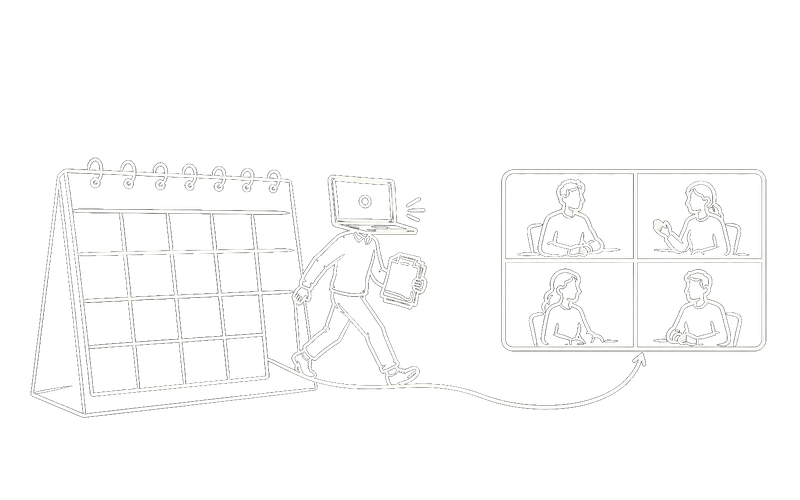
Pasting a meeting link works, and it is fine for the call you remembered. The interesting version is the one you did not have to remember, because your calendar already knew.
Connect Google Calendar and SKI sends your agent into a meeting, or a whole recurring series, right on time without you touching anything. The only condition is the one that makes it useful rather than creepy: the meeting's project has to be connected and active. Your agent turns up to the standup for the repository it is already working in.
The context is the point, not the attendance
A generic notetaker joins your call knowing nothing. It produces a transcript, which is a record of sounds, and a summary, which is a compression of that record. Useful, and about as useful as a very fast stenographer.
An agent that is already connected to the project arrives with a different kind of knowledge. It has the repository. It knows what the code currently does. So when somebody says “we agreed to keep the old endpoint until the migration lands”, that sentence is not just captured, it is checkable against what is actually in the branch.
That is the difference between a meeting bot and a colleague who happened to have read the code before walking in.
Attendance is easy. Turning up with the right context is the part that has always been hard.
You decide what it knows
Because the connection is per project, the scoping is yours and it is explicit. A meeting attached to the billing repository does not carry the infrastructure repository in with it. You are not handing over a general-purpose assistant with access to everything you own; you are sending the agent that belongs to that piece of work, into the meeting about that piece of work.
That matters more the more meetings you send it to. Broad access is convenient exactly once and uncomfortable thereafter.
Two ways to show up
- Agent: it is a live participant. It speaks, answers questions, and can summarise the discussion in the call. It sees the shared screen, can share its own, and reads and sends meeting chat.
- Transcript only: a silent notetaker. It listens and captures, and says nothing.
Both produce a speaker-tagged transcript and written notes. The choice is really about whether the meeting benefits from a participant or just needs a record, and for recurring series most people pick silent and never change it.
Where recurring series earn their keep
The single-meeting case is convenience. The recurring case is where it changes something.
Think about a weekly sync on a project you own. Over a quarter that is thirteen meetings, and the useful content is distributed thinly across all of them: a decision here, a constraint mentioned in passing there, a deadline that moved twice. No human retains that. People re-litigate settled questions because nobody can prove they were settled.
With every instance captured against the same project, the record becomes continuous rather than thirteen separate documents. You can ask across the series instead of hunting through it:
“When did we decide to drop the v1 endpoint, and has anything since contradicted it?”
That question spans thirteen transcripts and a codebase. It is not a question you can ask a folder of summaries, and it is the one that saves the most time, because the alternative is a fifteen-minute meeting about what was decided in a previous meeting.
The collaboration effect
There is a second-order thing that shows up after a few weeks of this, and it is not about notes.
When the record is reliable and everyone can query it, meetings stop being where information gets stored and become where decisions get made. The recap ritual disappears, because catching up no longer requires a person to perform it. Absent people stop being blockers. And the meeting that existed purely so that four people would hear the same thing at the same time starts looking optional.
Fewer meetings, shorter meetings, and the ones that remain being about the decision rather than the summary. That is the actual return, and it takes a month or so to notice.
What it costs, plainly
Sending an agent into a live call is SKI's one paid feature, billed per minute through AgentCall, with free hours included. It costs money because a bot in a cloud meeting has to run on a machine that stays connected for the whole call, and that machine cannot be your laptop.
Everything else stays free forever, including voice coding and the local meeting recorder. If you are attending the meeting yourself, use the recorder: it captures the same audio on your own machine, nothing joins the call, and it is unlimited. Auto-join is for the meetings you are not in.
More on choosing between the two in two ways to get your agent into a meeting.