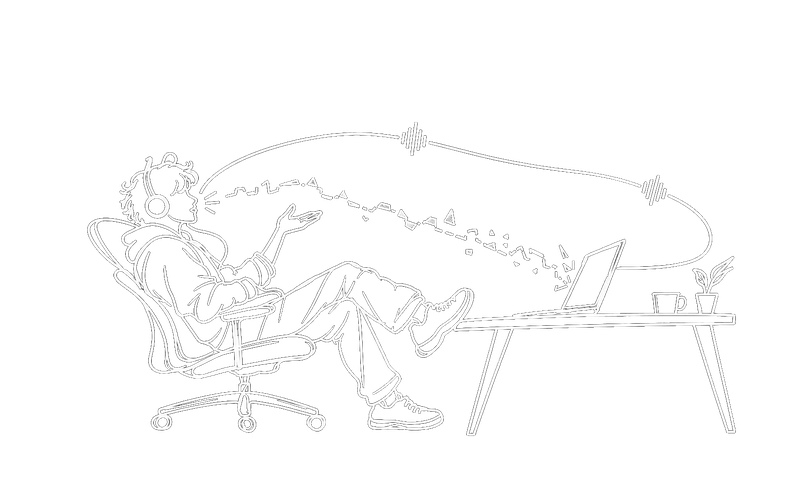
Nobody puts this on a landing page, because it sounds soft next to throughput and latency. But the thing people actually say after a week of voice coding is not that they are faster. It is that the work feels less lonely.
Which is a strange sentence to write about a developer tool, so it is worth being precise about what is happening, because it is not sentimentality. It is a real change in the shape of the day.
Solo work is quiet in a way people underestimate
Most programming is done alone, in silence, for hours. That is normal enough that we stopped noticing it is unusual. Almost no other skilled job works this way: surgeons talk, pilots talk, chefs shout, musicians count each other in. Developers sit still and type, and the only voice in the room is the one in your head.
Pairing is the exception, and everyone knows the feeling of a good pairing session, where the work is better and the four hours pass differently. Then your pair leaves and you are back to silence and a text editor.
The tiredness at the end of a long solo day is not only cognitive. Some of it is the plain effort of holding an entire problem alone with nobody to hand any of it to.
You are not tired because the problem was hard. You are tired because you carried all of it by yourself.
What changes when something answers
Voice coding does not simulate a colleague, and it would be dishonest to claim it does. What it changes is narrower and more mechanical: the room stops being silent, and you stop being the only one who knows what is going on.
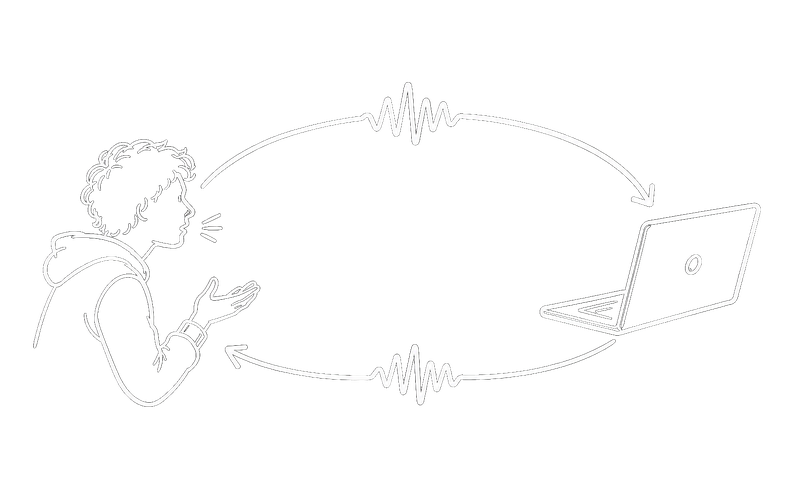
You say what you are about to try. Something goes and tries it. It comes back and tells you what happened, out loud, and you answer without turning around. That is the rhythm of working with somebody, and it turns out most of the feeling comes from the rhythm rather than from the somebody.
People describe it in two different ways, and both are recognisable:
- Like a junior developer. You hand off the parts you have already decided, and it comes back with them done and a question. You do the deciding; it does the fetching.
- Like a senior you can think out loud at. You describe what is confusing you, in the messy version, and something answers with the bit you were missing.
Which one it feels like mostly depends on what you asked, and both are better than the third option, which is nobody.
Thinking out loud is not a personality trait
Some people process by talking. That is well understood socially and completely unsupported by developer tooling, where the only output channel is a keyboard.
If you are one of those people, solo programming has always been slightly uphill. Not because the work is harder, but because the mode you think best in is unavailable, so you translate everything into typing first. Voice coding removes the translation step. You get to think the way you actually think, and the thing you are thinking at goes and does something about it.
If you are not one of those people, this argument will land differently, and that is fine. Plenty of developers find silence productive and would not want a voice in it. Silent mode exists for exactly that reason.
The part that is just more fun
Under the productivity argument there is a smaller and less respectable one: it is more enjoyable.
Saying “right, try it with the cache disabled” and hearing an answer come back is more fun than typing the same thing into a box and watching a spinner. Working at midnight is less bleak when something in the room is working with you. When you run several projects at once, each answering in its own voice, it stops feeling like software and starts feeling like a small team that happens to be very literal.
None of that shows up in a benchmark. It shows up in whether you are still willing to open the laptop on a Thursday evening.
The honest boundary
This is a real effect and it is also not friendship. It does not know how your week went, it will not tell you the thing you needed to hear, and it is not a substitute for a team, a pair, or people. Anyone selling an agent as a cure for isolation is selling something worse than a coding tool.
What it does do is remove the silence from the hours you were always going to spend alone anyway, and give the work a back and forth it did not have. That is a smaller claim, and it happens to be true.
If you want to try it, the loop runs entirely on your own machine and is free for life. Start with one project and notice, at the end of the day, whether you are as tired as usual.