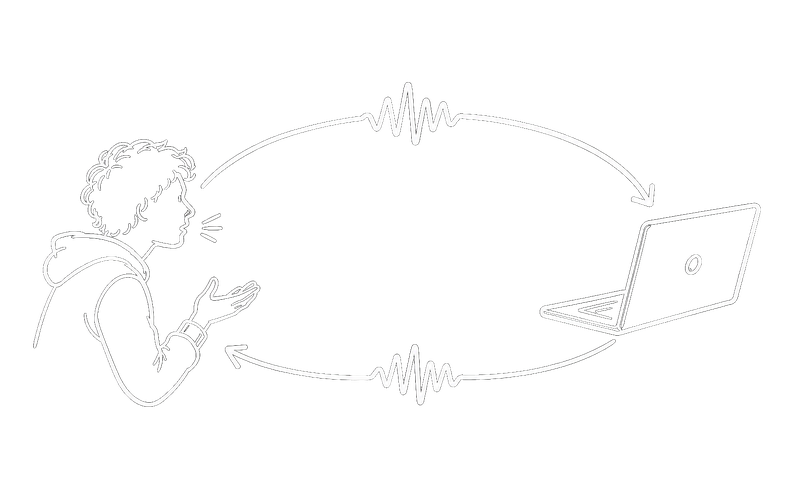
Every few years a phrase gets a second life. Voice coding is having one right now — and almost everything written about it still describes a tool that stopped making sense the moment coding agents arrived.
- Dictation aimed speech at characters. You pronounced syntax, and it was miserable.
- Agents moved the target to intent. You describe the change; the agent writes the code.
- So the loop has to close both ways. An agent that hears you but can't answer still chains you to the screen.
Dictation was a workaround
Before coding agents, speaking to a computer about code meant dictation. You spoke source into a grammar-based recognizer, one token at a time:
"const open bracket is Open comma set Is Open close bracket equals use State open paren false close paren"
The good systems were remarkable engineering, and for developers who couldn't type — RSI, injury, chronic pain — they were the difference between having a career and losing one. But nobody picked them up for pleasure. Speaking code aloud is a fight against the medium: source is dense with symbols that have no comfortable spoken form, and human speech evolved to carry meaning, not punctuation.
That sentence above takes about eleven seconds to say correctly, and one misheard word corrupts the line. Typing it takes four. So voice coding stayed exactly where it started: a heroic workaround for people who had no alternative, and a curiosity for everyone else.
The bottleneck was never the microphone. It was what we were aiming it at.
Then the target moved
Coding agents inverted the premise. You no longer have to say the code, because you no longer have to write the code. The unit of work moved up a level — from characters to intent.
"Add rate limiting to the upload endpoint — ten requests a minute per user — and write tests for it."
Twenty words. Four seconds. It produces work that would have cost you the better part of an hour. And critically: that sentence is comfortable to say out loud. No punctuation to pronounce, no casing to spell, no grammar to memorize. It's just a normal thing one person says to another.
That's the unlock — and it isn't better speech recognition. Recognition got good years ago. What changed is that there's finally something worth talking to.
| Dictation | Voice coding | |
|---|---|---|
| What you say | the code itself, symbol by symbol | what you want changed |
| What comes back | characters on a line | working, tested changes |
| What you learn first | a command grammar | nothing |
| Who it was built for | people who couldn’t type | anyone who’d rather not |
| When it fails | a symbol is misheard | you were vague, so you say it again |
| Where it ends | your words are on the screen | the agent tells you what it did |
Dictation asked you to speak like a compiler. Voice coding asks you to speak like a colleague.
Delegation, not transcription
This is why the term needs redefining rather than retiring. Voice coding in 2026 is not transcription — it's delegation. You aren't using your voice to produce characters. You're using it to hand off work.
spoken
typed, sustained
leaving your machine
The speed argument is real, but it's the least interesting part. The real change is the collapse in activation energy.
Think about the idea you had at 4pm — the refactor you noticed, the test you knew was missing, the question about why the build got slow. Typing it means stopping, switching windows, and finding the words in text. Most of those thoughts die right there, from friction alone. When the cost of acting is one spoken sentence, the ones that used to die get acted on instead.
Here is what that actually sounds like across an afternoon. Not prompts — sentences:
- “Why don’t we cache this response?”
- “Add a test for the empty state.”
- “Look through this module and tell me why the build got slower.”
- “Refactor this so we can support multiple providers.”
None of those need a perfect prompt, a command to remember, or a translation into anything. You say the thing you were already thinking.
Half a conversation isn't a conversation
Here's where most tools stop, and where we think they get it wrong.
Giving an agent ears is the easy half. Plenty of things will turn your speech into a prompt. But if your agent can hear you and can't answer, you're still tethered to the screen — watching a terminal scroll, waiting to learn whether it understood you. You didn't leave the keyboard. You just moved your hands off it.
So the loop has to close. The reply has to come back out loud, in a voice you don't mind listening to, while you're looking somewhere else. And it has to be interruptible: real conversations involve talking over each other, so full-duplex echo cancellation isn't a nice-to-have — it's the difference between a conversation and a walkie-talkie.
That return path is the part we spent the most time on, and it's the part we'd argue defines the category. Voice coding is a two-way channel, or it's just fancy dictation with extra steps.
And once the reply comes back out loud, something else becomes possible: the agent can ask you a question instead of guessing.
“Add authentication to this endpoint.”
“There are two auth patterns in this project. Should I follow the middleware the payments API uses?”
That is the whole difference in one exchange. You are not dictating to a computer; you are settling a detail with something that read the code first. And when it gets the wrong end of the stick, you correct it the way you’d correct a colleague — “no, not that file, I meant the upload handler” — without touching anything.
On-device, or it doesn't count
One more thing we won't compromise on. Your voice is biometric data, and your codebase is very likely not yours to upload. A tool that ships both to someone else's servers so it can be marginally more convenient has made that trade on your behalf, usually without asking.
Recognition and speech synthesis both run on your own machine. Nothing you say leaves it. This started as a privacy position and turned out to be a product one too — there's no network round trip in the loop, so replies come back at conversational speed rather than web-request speed.
The difference is easiest to feel as a shape. A cloud round trip goes:
speak → upload → wait → process → download → hear
On-device, it goes:
speak → think → answer
That gap is barely noticeable once. It is the entire experience when you are talking to something all day.
Why we built it
We built SKI because we wanted this for ourselves and it didn't exist: not a dictation tool bolted onto an editor, but a spoken loop with an agent that works while you talk and answers when it's done.
The IDE changed how developers work with code. Coding agents changed how developers work with software. Voice changes how developers work with the agents — and it is the first genuinely new interface for programming since the IDE arrived.
That doesn’t retire the keyboard, and it isn’t meant to. Sometimes you want to type, sometimes you want to point, sometimes you want to read the diff yourself. It just means the interface no longer has to stop at the keys.
So that is what we mean by voice coding in 2026. Not dictation, but delegation — and past delegation, conversation. The first was a workaround. The second is a tool. The third is a colleague, and it is the one we set out to build.
It works with Claude Code, Cursor, Codex, and any other agent you already use. If you want the practical version of this essay — five steps, no theory — that's the voice coding guide.